National September 11 Memorial Museum
National September 11 Memorial Museum
National September 11 Memorial Museum

San Francisco museum
The Exploratorium is an eye-opening,
playful place—in San Francisco and online—to explore how the
world works. For 40-plus years, we’ve offered creative,
thought-provoking exhibits, experiences, tools, and projects
that ignite curiosity, encourage exploration, and lead to profound learning.
Local Rates
National September 11 Memorial Museum
National September 11 Memorial Museum
National September 11 Memorial Museum
Bay Area Residents (nine-county area) receive local rates.
First Thursdays of the Month • 6:00 P.M.–10:00 P.M.
Exploratorium, Pier 15
$15 General; $10 Members; Free for
Lab Members
Note: The Exploratorium is open for adults (ages 18+) every
Thursday evening from 6:00–10:00 p.m. After Dark events are held on the first Thursday evening of each month.
Not a theater, cabaret, or gallery, After Dark contains aspects of all
three. Each evening showcases a different topic—from music to sex to
electricity—but all include a cash bar and film screenings, plus an
opportunity to play with our hundreds of hands-on exhibits. Join us and
mingle with inventive scientists, artists, musicians, programmers, and
designers. Enjoy live performances, provocative films, interesting
music, cutting-edge technology, unexpected extravaganzas, and more,
depending on each evening's lineup. And all night long, delicious
nibbles and outrageous bay views are available at the
SeaGlass restaurant. Leave
the kids at home and meet friends or take a date. Where else can you
find an intellectually stimulating playground for adults?
Thursday Evening Adult-Only Admission Tickets
Thursday evenings are exclusive adult-only hours for ages 18 and up.
All ages are welcome from 10:00 a.m. to 5:00 pm. We close at 5:00 p.m.
and reopen at 6:00 p.m., when we feature adult-only special programming,
along with cocktails. Our acclaimed
After Dark
series is on the first Thursday of each month. If you'd like to visit
before 5:00 p.m. and stay for evening adult-only hours, you must
purchase separate
daytime and evening tickets.
http://www.exploratorium.edu/visit/calendar/after-dark
Augmented Reality App
http://www.meldmedia.com/110059/1052081/work/augmented-reality-app
Mam after dark
Milwaukee Art Museum
http://mam.org/afterdark/
National September 11 Memorial Museum
National September 11 Memorial Museum
National September 11 Memorial Museum
National September 11 Memorial Museum
National September 11 Memorial Museum
The Museum tells the story of the events of 9/11 through artefacts that range in scale from the monumental to the intimate, as well as through first-person accounts and multimedia displays. The Museum gives voice to the experiences of many, shaping individual narratives into a story of global impact and a place for people from around the world to come together, bear witness, and reflect.
National September 11 Memorial Museum
National September 11 Memorial Museum
Acoustic Design | Jaffe Holden
Conservation | Art Preservation Services
Owner Representation | Zubatkin Owner Representation, LLC
Museum Architect | Davis Brody Bond, LLP
Pavilion Architect | Snøhetta
Construction Manager | Lend Lease
Project Brief
The National September 11 Memorial Museum presents
multiple perspectives on the experience of this complex and continually
evolving history. The Museum is designed to accommodate a wide spectrum
of users who feel, each in their own way, strong personal connections to
9/11. Designed with visitors’ varied personal experiences in mind,
along with evolving notions about the meaning of 9/11, the Muse
- See more at: http://newyorkdesignaward.com/nyc15/entry_details.asp?ID=13751&Category_ID=6521#sthash.V2UIztKn.dpuf
Physical materials and archaeological remnants provide a “here-and-now” museum experience—a safe environment for encountering difficult history. Digital materials—mostly narrative accounts—provide a compelling sense of the “there-and-then” of 9/11 without immersing people in a re-creation of the day. The Museum facilitates memorialization and mourning, gaining new perspectives on the events, and placing our own experiences and reflections on 9/11 into the context of others.
When considering audience, we realized that at the extremes there would be both insiders who survived the day and also those who know nothing about 9/11. Our core strategy was to use the stories from one to engage the other, leading us to rethink the idea of a museum as a platform for storytelling. Visitors share their own experiences and construct their own understanding; the Museum gathers these reflections, turning the experience into a collective act of memory.
Digital material was gathered in an open online call for 9/11 stories, simultaneously building a community, awareness of the project, and a new global archive. Visitors have the opportunity to leave a message by writing digitally at the Signing Steel interactive. Also novel is the seamless integration of media, artifact, and environment. Examples include the subtle use of projection on the concrete walls of the site and select steel artifacts in many of the exhibition areas, and the interplay of media-based storytelling with physical portraits, objects, and a sanctum-like innermost space whose glass floor reveals the fragmented concrete slab that was the original foundation of one of the Twin Towers.
http://newyorkdesignaward.com/nyc15/entry_details.asp?ID=13751&Category_ID=6521
Acoustic Design | Jaffe Holden
Conservation | Art Preservation Services
Owner Representation | Zubatkin Owner Representation, LLC
Museum Architect | Davis Brody Bond, LLP
Pavilion Architect | Snøhetta
Construction Manager | Lend Lease
Project Brief
The National September 11 Memorial Museum presents
multiple perspectives on the experience of this complex and continually
evolving history. The Museum is designed to accommodate a wide spectrum
of users who feel, each in their own way, strong personal connections to
9/11. Designed with visitors’ varied personal experiences in mind,
along with evolving notions about the meaning of 9/11, the Muse
- See more at: http://newyorkdesignaward.com/nyc15/entry_details.asp?ID=13751&Category_ID=6521#sthash.V2UIztKn.dpuf
Longing for Mecca–The Pilgrim’s Journey
The challenge was to create a personal exhibition accessible to a wide audience.
Longing for Mecca
takes visitors on the pilgrim’s journey, guiding them through a
step-by-step introduction to the Hajj. Previously on show at the British
Museum in London, it was redesigned and adapted for a Dutch audience.
Objects from various collections, personal stories, and in-depth
reports provide a comprehensive picture of the journey. Each space in
the exhibition represents a stage in the Hajj, made distinct through
light, color, objects, film, and sound.
Graphic design plays a significant role in the exhibition themes.
Each stage of the Hajj is represented by a different color. At the
entrance, texts from the Qur’an on pieces of fabric provide, for
instance, the setting in which a dynamic presentation of moving letters
was chosen deliberately. Stimulated by this “longing” for Mecca, in the
next room visitors receive practical tips on how to prepare for the
Hajj. An impressive range of facts and figures is presented graphically.
The long corridor that follows displays a series of maps that each show
a different route to Mecca.
https://segd.org/longing-mecca-exhibition
Tom Bradley International Terminal
Los Angeles International Airport
The digital media features are located along key points of engagement
in the passenger departure and arrival itineraries, and are integrated
within the architectural fabric of the terminal. Each feature, designed
with a distinct identity, acts as a "medium" with unique functionalities
in the integral media ecology.
The Time Tower is a 72-foot-tall, four-sided digital media structure
that serves as the orientation point for passengers in the terminal's
Great Hall. It not only provides the time, it expresses time through
slow-motion scenes and hourly clock strikes that celebrate moments in
LA's cinematic history. The Time Tower was programmed with four content
layers to create 3-D trompe l'oeil effects and an interactive base that
reacts to the gestures of passengers.
The Story Board, a 120-foot-array of eight digital displays visible
from multiple points across the expanse of the Great Hall, was designed
to serve as a canvas for ambient narratives. The Destination Board
reinterprets the traditional flight information display by using live
feeds to animate imagery and information about the destination cities.
The 82-foot-tall Welcome Wall greets arriving passengers with
high-definition video and welcome messages in their native languages,
keyed to the origin of arriving flights. The Bon Voyage Wall is directed
to departing passengers, offering video sendoffs expressive of Los
Angeles culture. The Portals, a series of ten 28-foot-tall stacked LCDs,
present imagery in the art traditions of the destination cities,
interactively programmed to react to passengers’ movements en route to
embarkation.
https://segd.org/lax-tom-bradley-international-terminal
The Ventspils Museum permanent exhibition
The Ventspils Museum permanent exhibition is located in the 13th
century Castle of the Livonian Order of Knights, one of the oldest
castles in Latvia. Design Studio H2E took this special context into
consideration in creating the exhibition. The team’s design concept is
based on the shards of history that have impacted the castle and the
port city over the course of centuries. The team translated the concept
of shards visually through asymmetrical, polygonal shapes that form
furniture, display cases, interactive stations, and other elements
throughout the exhibition. The design language was intended to create an
emotional and spatial adventure in itself; therefore, digital
technologies and interactives were dispensed sparingly.
The aesthetics of the broken lines (shards) symbolizes the
heterogeneous course of history with all its turns of power, facets, and
revolutions; the figurative shards illustrate the preserved fragments
of the former wholeness of time. In the exhibition, traditionally matte
materials were replaced with glass surfaces which, being achromatic,
absorb the colors of the surrounding space and give visitors a chance to
observe themselves in the mirrors of history, in historical context.
Glass surfaces were patinated (after a year of glazing experiments by
the design team), muting their brightness and avoiding any dissonance
with the historic environment.
https://segd.org/ventspils-museum-exhibition
Sherlock Holmes Exhibition
Enter the mind of the city’s most iconic consulting detective and for one night & immerse yourself in Sherlock's unique pursuits and habits. Plus get a combined ticket and see our Sherlock Holmes exhibition after hours. Including galleries by twilight and late night bars.
The evening's highlights:
Specially commissioned performance:Invitation to Fall with Amy Sharrocks
In
the Museum of London's spotlit theatre, inspired by the story of the
Reichenbach Falls in the Final Problem, you are invited to come for a
fall.
more information about this special commission
- See more at:
http://www.museumoflondon.org.uk/london-wall/whats-on/events-calendar/event-details/?eventID=6920#sthash.QCR5mK6r.dpuf
In the Museum of London's spotlit theatre, inspired by the story of the Reichenbach Falls in the Final Problem, you are invited to come for a fall.
Installation: Memory Maze
Wander through a maze of memories inspired by Sherlock. Learn the science behind memory and the mind and contribute your own recollections to creative science guru's,
Bartistu demos: a gentleman uses his brain over his brawn.
Learn the gentleman's art of self-defence, with Jujitsu expert and Bartitsu enthusiast,James Garvey who teaches the ancient art at the Idler Academy.
Comedy: Sherlock Improv
Give anyone who has ever written a Sherlock story a run for their money and join comedy improv gurus to help crowdsource some witty new sherlock sketches
Life Drawing
London Drawing use original canon excerpts to recreate a study of Sherlock's bohemian side
With talks from Sherlock Fashion curator, Tim Long, a memory expert and free reign to indulge your inner Sherlock geek with creative art workshoppers, Hurdy Gurdy.
Enter
the mind of the city’s most iconic consulting detective and for one
night only immerse yourself in Sherlock's unique pursuits and habits.
Plus get a combined ticket and see our Sherlock Holmes exhibition after
hours. Including galleries by twilight and late night bars.
The evening's highlights:
Specially commissioned performance:
Invitation to Fall with Amy Sharrocks
Installation: Memory Maze
Wander through a maze of
memories inspired by Sherlock. Learn the science behind memory and the
mind and contribute your own recollections to creative science guru's, Guerilla Science's, interactive memory repository. Designed in collaboration with Broqwiem.
Bartistu demos: a gentleman uses his brain over his brawn.
Learn the gentleman's art of self-defence, Bartistu, with Jujitsu expert and Bartitsu enthusiast, James Garvey who teaches the ancient art at the Idler Academy.
Comedy: Sherlock Improv
Give anyone who has ever written a Sherlock story a run for their money and join comedy improv gurus Shoot from the Hip! to help crowdsource some witty new sherlock sketches.
Life Drawing
London Drawing use original canon excerpts to recreate a study of Sherlock's bohemian side.
With talks from Sherlock
Fashion curator, Tim Long, a memory expert and free reign to indulge
your inner Sherlock geek with creative art workshoppers, Hurdy Gurdy.
- See more at:
http://www.museumoflondon.org.uk/london-wall/whats-on/events-calendar/event-details/?eventID=6920#sthash.QCR5mK6r.dpuf
http://www.museumoflondon.org.uk/london-wall/whats-on/events-calendar/event-details/?eventID=6920
Scare Tactics
In the video-game industry, the fastest way to the hearts of gamers is to
immerse them in an experience so realistic that the forces of evil
could jump out of the screen. Capcom USA Inc. has done just that with
its "Dead Rising" video games that turn players into slayers in a
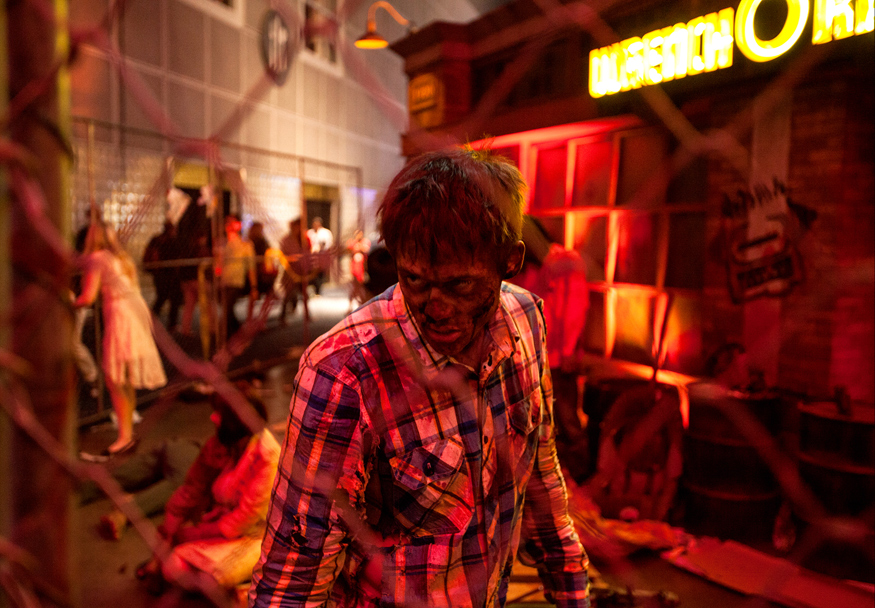
zombie-infested town. But to bring its fear factor to attendees at the
2013 Electronic Entertainment Expo, Capcom made its zombies jump off the
screen – literally – by planting them right on the show floor in all
their staggering glory.
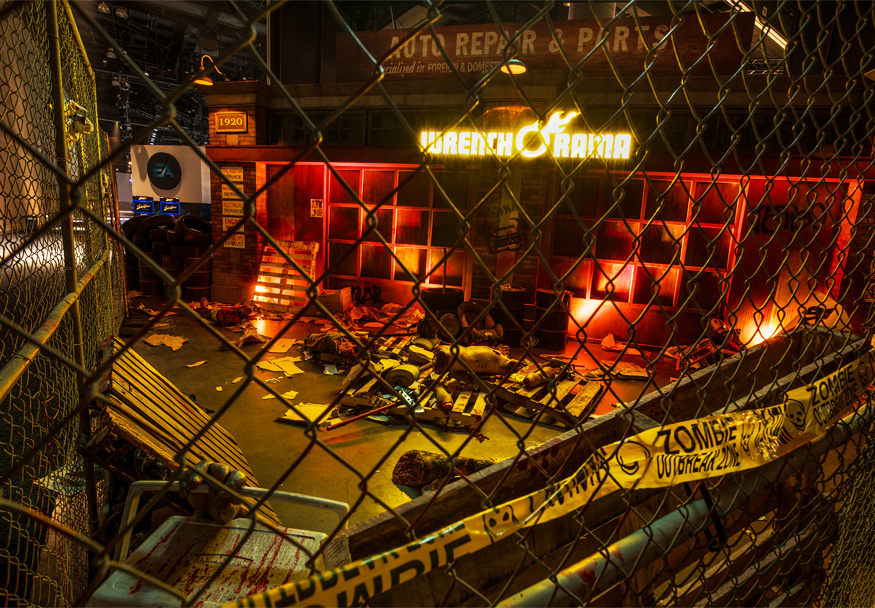
Capcom's "Dead Rising 3" display was the Wrench-O-Rama garage, a
setting plucked right from the game and meticulously recreated.
Encompassing an area of 365 square feet, the triangular space had two
aisle-facing sides, each with 27 feet of frontage, and was caged by a
tall chain-link fence along the perimeter. Inside, zombies lurched and
snarled, reaching through and thrashing against the chain link in an
effort to get at passersby.
Designers at Pinnacle Exhibits Inc. made the stability of the fence
appear sketchy, causing attendees to jump back in fear when the
creatures threw themselves against it and seemed as if they might break
free.
http://www.exhibitoronline.com/topics/article.asp?ID=1631&catID=72